CommandLineArguments Class Reference
#include <CommandLineArguments.hpp>
Inherits boost::noncopyable.
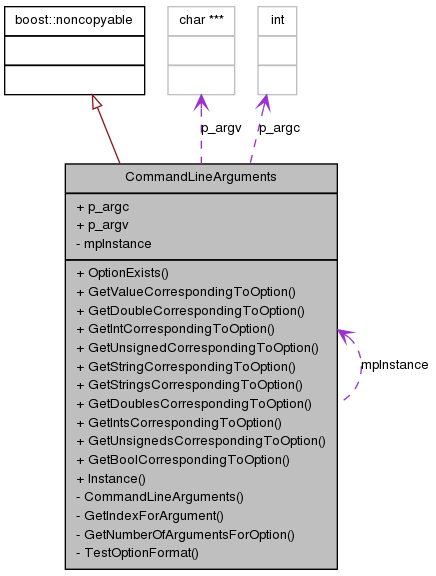
Public Member Functions | |
| bool | OptionExists (const std::string &rOption) |
| char * | GetValueCorrespondingToOption (const std::string &rOption, int valueNumber=1) |
| double | GetDoubleCorrespondingToOption (const std::string &rOption, int valueNumber=1) |
| int | GetIntCorrespondingToOption (const std::string &rOption, int valueNumber=1) |
| unsigned | GetUnsignedCorrespondingToOption (const std::string &rOption, int valueNumber=1) |
| std::string | GetStringCorrespondingToOption (const std::string &rOption, int valueNumber=1) |
| std::vector< std::string > | GetStringsCorrespondingToOption (const std::string &rOption) |
| std::vector< double > | GetDoublesCorrespondingToOption (const std::string &rOption) |
| std::vector< int > | GetIntsCorrespondingToOption (const std::string &rOption) |
| std::vector< unsigned > | GetUnsignedsCorrespondingToOption (const std::string &rOption) |
| bool | GetBoolCorrespondingToOption (const std::string &rOption) |
Static Public Member Functions | |
| static CommandLineArguments * | Instance () |
Public Attributes | |
| int * | p_argc |
| char *** | p_argv |
Private Member Functions | |
| CommandLineArguments () | |
| int | GetIndexForArgument (std::string argument) |
| int | GetNumberOfArgumentsForOption (const std::string &rOption) |
| void | TestOptionFormat (const std::string &rOption) |
Static Private Attributes | |
| static CommandLineArguments * | mpInstance = NULL |
Detailed Description
A convenient holder for the command line arguments, with helper methods for checking whether an option has been given or getting the value(s) corresponding to a given option.
Options are considered to be any argument starting with a '-' followed by a non-numeric character, in order to distinguish between options and negative numbers. Each option may have zero or more values following it on the command line. Examples:
- -option1 on
- --my_param value
- --verbose
- -numbers 1 8 -4.5
- --models model1 model2
The cxxtest harness will fill in the member variables when a test is started. They can then be read by PETSc when it is initialised, and by other code as required.
Definition at line 62 of file CommandLineArguments.hpp.
Constructor & Destructor Documentation
| CommandLineArguments::CommandLineArguments | ( | ) | [private] |
Default constructor. Should never be called directly, call CommandLineArguments::Instance() instead.
Definition at line 42 of file CommandLineArguments.cpp.
References mpInstance.
Member Function Documentation
| bool CommandLineArguments::GetBoolCorrespondingToOption | ( | const std::string & | rOption | ) |
Read bools from the command line. This accepts 0 or 1, and also true/True/TRUE and false/False/FALSE.
- Parameters:
-
rOption The option name as a string.
- Returns:
- Whether the option was set to true or false.
Definition at line 196 of file CommandLineArguments.cpp.
References EXCEPTION, and GetStringCorrespondingToOption().
| double CommandLineArguments::GetDoubleCorrespondingToOption | ( | const std::string & | rOption, | |
| int | valueNumber = 1 | |||
| ) |
- Returns:
- the double for a given option.
This uses GetValueCorrespondingToOption and converts the char* to a double.
- Parameters:
-
rOption the option name as a string. valueNumber the number of the argument following the option definiton (defaults to 1, for 1st argument).
Definition at line 81 of file CommandLineArguments.cpp.
References GetValueCorrespondingToOption().
Referenced by GetDoublesCorrespondingToOption().
| std::vector< double > CommandLineArguments::GetDoublesCorrespondingToOption | ( | const std::string & | rOption | ) |
- Returns:
- a collection of doubles for a given option.
This uses GetDoubleCorrespondingToOption repeatedly.
- Parameters:
-
rOption the option name as a string.
Definition at line 163 of file CommandLineArguments.cpp.
References GetDoubleCorrespondingToOption(), and GetNumberOfArgumentsForOption().
| int CommandLineArguments::GetIndexForArgument | ( | std::string | argument | ) | [private] |
- Returns:
- the index for the given argument. Returns -1 if the argument is not found.
- Parameters:
-
argument the argument name as a string.
- Returns:
- the position of the argument in the list (indexed from 1)
Definition at line 104 of file CommandLineArguments.cpp.
References p_argc, p_argv, and TestOptionFormat().
Referenced by GetNumberOfArgumentsForOption(), GetValueCorrespondingToOption(), and OptionExists().
| int CommandLineArguments::GetIntCorrespondingToOption | ( | const std::string & | rOption, | |
| int | valueNumber = 1 | |||
| ) |
- Returns:
- the int for a given option.
This uses GetValueCorrespondingToOption and converts the char* to an int.
- Parameters:
-
rOption the option name as a string. valueNumber the number of the argument following the option definiton (defaults to 1, for 1st argument).
Definition at line 87 of file CommandLineArguments.cpp.
References GetValueCorrespondingToOption().
Referenced by GetIntsCorrespondingToOption().
| std::vector< int > CommandLineArguments::GetIntsCorrespondingToOption | ( | const std::string & | rOption | ) |
- Returns:
- a collection of ints for a given option.
This uses GetIntCorrespondingToOption repeatedly.
- Parameters:
-
rOption the option name as a string.
Definition at line 185 of file CommandLineArguments.cpp.
References GetIntCorrespondingToOption(), and GetNumberOfArgumentsForOption().
| int CommandLineArguments::GetNumberOfArgumentsForOption | ( | const std::string & | rOption | ) | [private] |
- Returns:
- the number of arguments for a given option. Throws an Exception if the option does not have any following arguments, or the option does not exist. So you can use OptionExists() to avoid Exceptions in your code when using the other public methods.
- Parameters:
-
rOption the option name as a string.
- Returns:
- the number of arguments following this option.
Definition at line 118 of file CommandLineArguments.cpp.
References EXCEPTION, GetIndexForArgument(), p_argc, and p_argv.
Referenced by GetDoublesCorrespondingToOption(), GetIntsCorrespondingToOption(), GetStringsCorrespondingToOption(), GetUnsignedsCorrespondingToOption(), and GetValueCorrespondingToOption().
| std::string CommandLineArguments::GetStringCorrespondingToOption | ( | const std::string & | rOption, | |
| int | valueNumber = 1 | |||
| ) |
- Returns:
- the string for a given option.
This uses GetValueCorrespondingToOption and converts the char* to a std::string.
- Parameters:
-
rOption the option name as a string. valueNumber the number of the argument following the option definiton (defaults to 1, for 1st argument).
Definition at line 145 of file CommandLineArguments.cpp.
References GetValueCorrespondingToOption().
Referenced by GetBoolCorrespondingToOption(), and GetStringsCorrespondingToOption().
| std::vector< std::string > CommandLineArguments::GetStringsCorrespondingToOption | ( | const std::string & | rOption | ) |
- Returns:
- a collection of strings for a given option (useful for inputting a list of files for example).
This uses GetStringCorrespondingToOption repeatedly.
- Parameters:
-
rOption the option name as a string.
Definition at line 152 of file CommandLineArguments.cpp.
References GetNumberOfArgumentsForOption(), and GetStringCorrespondingToOption().
| unsigned CommandLineArguments::GetUnsignedCorrespondingToOption | ( | const std::string & | rOption, | |
| int | valueNumber = 1 | |||
| ) |
- Returns:
- the unsigned for a given option.
This uses GetValueCorrespondingToOption and converts the char* to an unsigned. Throws an exception if the option converts to a negative integer.
- Parameters:
-
rOption the option name as a string. valueNumber the number of the argument following the option definiton (defaults to 1, for 1st argument).
Definition at line 93 of file CommandLineArguments.cpp.
References EXCEPTION, and GetValueCorrespondingToOption().
Referenced by GetUnsignedsCorrespondingToOption().
| std::vector< unsigned > CommandLineArguments::GetUnsignedsCorrespondingToOption | ( | const std::string & | rOption | ) |
- Returns:
- a collection of unsigneds for a given option.
This uses GetUnsignedCorrespondingToOption repeatedly.
- Parameters:
-
rOption the option name as a string.
Definition at line 174 of file CommandLineArguments.cpp.
References GetNumberOfArgumentsForOption(), and GetUnsignedCorrespondingToOption().
| char * CommandLineArguments::GetValueCorrespondingToOption | ( | const std::string & | rOption, | |
| int | valueNumber = 1 | |||
| ) |
- Returns:
- the value for a given option, i.e. the argument after the option name in the list of command line arguments. For example, if the following arguments were given ./heart/build/debug/TestMyClassRunner -timestep 0.04 Then calling CommandLineArguments::Instance()->GetValueCorrespondingToOption("-timestep"); will return 0.04 (as a char*). Use atoi or atof to convert the char* to an int or a double(float) respectively, or call one of our convenience methods for common types.
- Parameters:
-
rOption the option name as a string. valueNumber the number of the argument following the option definiton (defaults to 1, for 1st argument).
Definition at line 69 of file CommandLineArguments.cpp.
References EXCEPT_IF_NOT, GetIndexForArgument(), GetNumberOfArgumentsForOption(), p_argv, and TestOptionFormat().
Referenced by GetDoubleCorrespondingToOption(), GetIntCorrespondingToOption(), GetStringCorrespondingToOption(), and GetUnsignedCorrespondingToOption().
| CommandLineArguments * CommandLineArguments::Instance | ( | ) | [static] |
- Returns:
- the single instance of this class.
Definition at line 50 of file CommandLineArguments.cpp.
References mpInstance.
Referenced by AbstractContinuumMechanicsSolver< DIM >::AbstractContinuumMechanicsSolver(), AbstractNonlinearElasticitySolver< DIM >::AbstractNonlinearElasticitySolver(), IncompressibleNonlinearElasticitySolver< DIM >::AssembleSystem(), CompressibleNonlinearElasticitySolver< DIM >::AssembleSystem(), CommandLineArgumentsMocker::CommandLineArgumentsMocker(), FineCoarseMeshPair< DIM >::ComputeCoarseElementsForFineElementCentroids(), FineCoarseMeshPair< DIM >::ComputeCoarseElementsForFineNodes(), FineCoarseMeshPair< DIM >::ComputeFineElementsAndWeightsForCoarseNodes(), FineCoarseMeshPair< DIM >::ComputeFineElementsAndWeightsForCoarseQuadPoints(), AbstractContinuumMechanicsAssembler< DIM, CAN_ASSEMBLE_VECTOR, CAN_ASSEMBLE_MATRIX >::DoAssemble(), PetscSetupUtils::InitialisePetsc(), ExecutableSupport::InitializePetsc(), CardiacElectroMechanicsProblem< DIM, ELEC_PROB_DIM >::Solve(), and CommandLineArgumentsMocker::~CommandLineArgumentsMocker().
| bool CommandLineArguments::OptionExists | ( | const std::string & | rOption | ) |
- Returns:
- true if a given option exists in the command line arguments.
- Parameters:
-
rOption the option name as a string.
Definition at line 61 of file CommandLineArguments.cpp.
References GetIndexForArgument().
Referenced by AbstractContinuumMechanicsSolver< DIM >::AbstractContinuumMechanicsSolver(), AbstractNonlinearElasticitySolver< DIM >::AbstractNonlinearElasticitySolver(), IncompressibleNonlinearElasticitySolver< DIM >::AssembleSystem(), CompressibleNonlinearElasticitySolver< DIM >::AssembleSystem(), FineCoarseMeshPair< DIM >::ComputeCoarseElementsForFineElementCentroids(), FineCoarseMeshPair< DIM >::ComputeCoarseElementsForFineNodes(), FineCoarseMeshPair< DIM >::ComputeFineElementsAndWeightsForCoarseNodes(), FineCoarseMeshPair< DIM >::ComputeFineElementsAndWeightsForCoarseQuadPoints(), AbstractContinuumMechanicsAssembler< DIM, CAN_ASSEMBLE_VECTOR, CAN_ASSEMBLE_MATRIX >::DoAssemble(), and CardiacElectroMechanicsProblem< DIM, ELEC_PROB_DIM >::Solve().
| void CommandLineArguments::TestOptionFormat | ( | const std::string & | rOption | ) | [private] |
Throw an exception if the option is not of the required form: '-' followed by a non-numeric character.
- Parameters:
-
rOption the option name to check the format of.
Definition at line 221 of file CommandLineArguments.cpp.
References EXCEPTION.
Referenced by GetIndexForArgument(), and GetValueCorrespondingToOption().
Member Data Documentation
CommandLineArguments * CommandLineArguments::mpInstance = NULL [static, private] |
The single instance of the class.
Definition at line 70 of file CommandLineArguments.hpp.
Referenced by CommandLineArguments(), and Instance().
The number of command line arguments.
Definition at line 100 of file CommandLineArguments.hpp.
Referenced by CommandLineArgumentsMocker::CommandLineArgumentsMocker(), GetIndexForArgument(), GetNumberOfArgumentsForOption(), PetscSetupUtils::InitialisePetsc(), ExecutableSupport::InitializePetsc(), and CommandLineArgumentsMocker::~CommandLineArgumentsMocker().
| char*** CommandLineArguments::p_argv |
The arguments themselves.
Definition at line 103 of file CommandLineArguments.hpp.
Referenced by CommandLineArgumentsMocker::CommandLineArgumentsMocker(), GetIndexForArgument(), GetNumberOfArgumentsForOption(), GetValueCorrespondingToOption(), PetscSetupUtils::InitialisePetsc(), ExecutableSupport::InitializePetsc(), and CommandLineArgumentsMocker::~CommandLineArgumentsMocker().
The documentation for this class was generated from the following files:
- global/src/CommandLineArguments.hpp
- global/src/CommandLineArguments.cpp
